

It’s barely noon. You’re sitting at your workspace, juggling tabs, shoulders slouched and drained. You’ve tried those Pinterest-perfect work-from-home routines. But still feel that you are withering away.
Not the dream you signed up for? I get it.
After a year working from home, I noticed a problem. Most WFH routine advice assumes you always have energetic days. Worse? The advice might apply to seasoned remote workers, but not to beginners.
That’s what makes this piece different. I’ll share a realistic, flexible WFH schedule template I use. It’s designed for tired knowledge workers.
Let’s help you enjoy the freedom of remote work.
Why Most Work-From-Home Routines Make You Tired
You know those pretty WFH routines you see online?
Wake up at 5 a.m. Make fresh coffee–5:30. Journal in soft sunlight–6 a.m. Then three hours of deep work, with cute plants sitting beside the laptop, appearing to thrive more than you are.
It almost feels like you’re on a sandy beach, with a gentle breeze, and nothing urgent happening. Then, you try the routine. And real life happens.
You wake up later than planned. Your internet misbehaves. Or you don’t feel like doing the 3-hour deep study anymore.
For a long time, I considered myself undisciplined. Maybe I need a better routine that sketched my entire day down to the minute.
But work-from-home invites more mental circus than it looks, and an ideal routine misses how to avoid burnout while working from home.
Why working from home feels exhausting even without long hours
Remote work often brings information overload and pressure to perform as a new employee.
You’re doing beyond your job. You’re also managing time, switching from crafting a LinkedIn post to joining a meeting. Then, you’re attending to family needs and learning AEO (Answer Engine Optimization).
In 2017, Ayoun Suh and Jumin Lee researched 258 teleworkers from two global IT companies. Here’s what they found.
Technology and job-related factors contributed to techno-stress. Work overload, blurred privacy and unclear roles were among the sources of strain identified in the study.
Sometimes, the workload isn’t what wears you out. It’s the constant bouncing between tasks, messages, and the extra mental effort of staying organized while working from home.
The Productivity Myth of a More Structured Routine
I made things worse here. Thinking the solution was to structure everything perfectly.
Eventually, I was spending more energy constantly managing the routine that it became another job. Monitoring. Adjusting. Feeling guilty. That drains mental energy for high-cognitive tasks.
Research on decision fatigue suggests that making lots of decisions can leave you with less energy to make good choices later.
That doesn’t mean a system is bad. A few simple habits can make your day easier. But your routine shouldn’t become another test to fail.
If you’re always asking, “What should I do first?” Or “Should I reply now or later?” Your routine may need fewer decisions to make your day lighter.
A quick note: This article is general information, not medical advice. A routine may help with daily overwhelm, but it cannot fix every cause of fatigue or burnout. If symptoms persist, please seek professional healthcare advice.
What a Realistic WFH Routine Needs
For me, a productive work-from-home routine needs to work on an ordinary Tuesday when you’re tired, distracted, busy or under the weather.
Here are some of the best work-from-home tips that’s infused joy to my daily routine:
1. Know what needs to get done
Before filling your day with tasks, ask:
What needs to happen today?
Nobody is awarding medals for a productivity Olympics. Not with 15 tasks glaring at you from a planner. Choose one to three small things that would make your day feel like progress.
That could be one important work sub-task, studying for 30 minutes or applying for one job.
2. Work with your energy, not against it
Your energy isn’t exactly the same every day.
Some days, you might concentrate for two hours. Another day, 15 minutes might be enough. That doesn’t mean you’ve become lazy. It means your routine needs different versions.
A high-energy day might have more demanding work and longer focus sessions. A low-energy day might call for shorter and simpler tasks.
And if you’re working while studying, job hunting or building new skills? Create space for those things too.
3. Make switching between roles easier
Gig work can mean moving between several roles without commuting.
One moment, you’re an employee, and the next, you’re a spouse. Then, you’re back at your laptop, and your brain is like, “Ma’am, what exactly are we doing?”
You can’t control every interruption, but small signals can help.
For instance, making tea before work, shoveling away your books, and shutting down your laptop. It tells your brain: Okay, we’re moving on now.
4. Leave room for days that go sideways
An unexpected Slack meeting may pop up. Or you might wake up feeling like your brain needs five business days to boot.
So your routine needs somewhere for those disrupted days to breathe.
Instead of throwing the whole thing away, scale it down. Do one essential task, communicate to your team and let the rest wait if it needs to.
A realistic routine changes with your energy and leaves room for life’s shenanigans.
A Flexible WFH Routine Template You Can Adapt
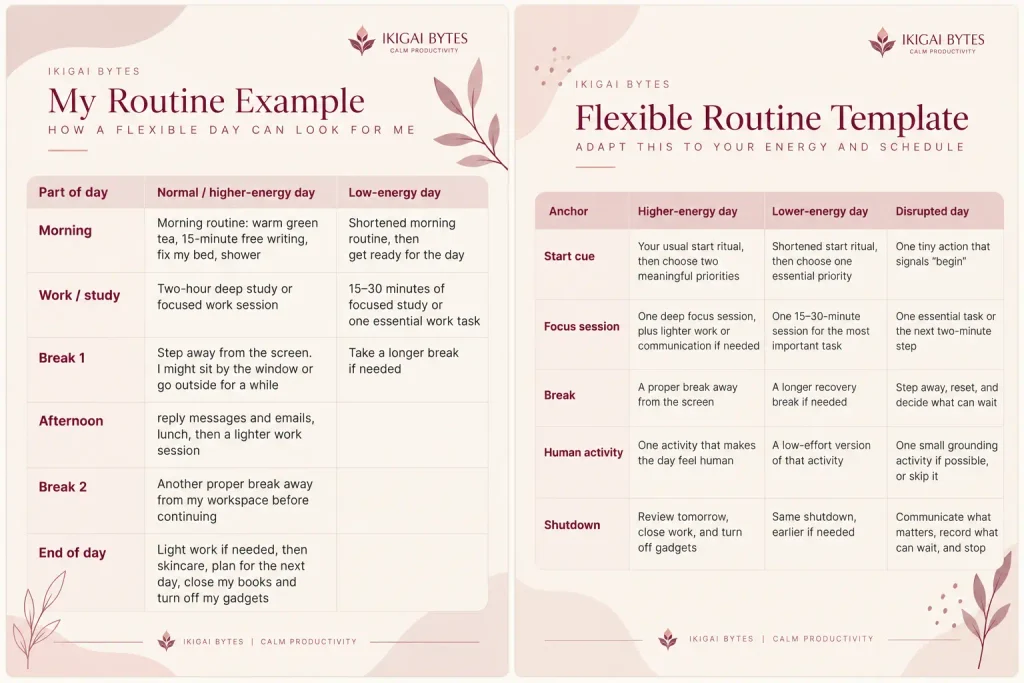
Try this simple daily routine template and adapt it to your life.
It isn’t a schedule telling you what to do from 8 a.m. to 5 p.m. It gives you a few signposts throughout the day and lets you decide what each day needs.
Your job, home setup, energy pattern, and team expectations can affect what this looks like. Use the template as a guide, not a rule.
The template has five signposts:
- Start cue: Something small that tells your brain, Okay, we’re starting now. This could be tea, a brief journal entry, prayer or simply sitting down at your workspace.
- Focus session: Choose the work that matters most. This might be deep work, writing, or something lighter such as email and admin. Listen to your energy.
- Proper break: Step away from the screen. Stroll outside, sit by the window, eat, stretch, dance or do something that gives your eyes and mind a break.
- Human activity: Leave space for being a person, not just a worker. Walk, cook, read a novel, call someone, garden or do hobbies you enjoy.
- Shutdown: Mark the end of the day. Note what’s unfinished, decide what comes next and close your laptop.
You don’t have to do all five anchors each day. If one doesn’t help, leave it out. The goal is to make your workday feel weightless.
These anchors make it easier to begin and end my day and adapt when energy drops. Over time, I stopped trying to manage a rigid routine, and started noticing what I had completed.
The result? My week feels less like a race-against-time and more like steady progress.
Download your free realistic WFH routine template.
My Actual Work-From-Home Routine (Example)
I adapt the template above depending on my energy and what needs to happen.
On a normal or high-energy day, my WFH morning routine starts with warm green tea. Next: 15-minute free writing, fixing bed, shower, breakfast, and sometimes gardening. Then I slide into deep work or study.
I prefer demanding work earlier because I’m more alert in the morning. But that doesn’t mean everyone needs to work at sunrise. If you’re a night owl, work night shifts or work across time zones, use the same idea around the time your brain works best.
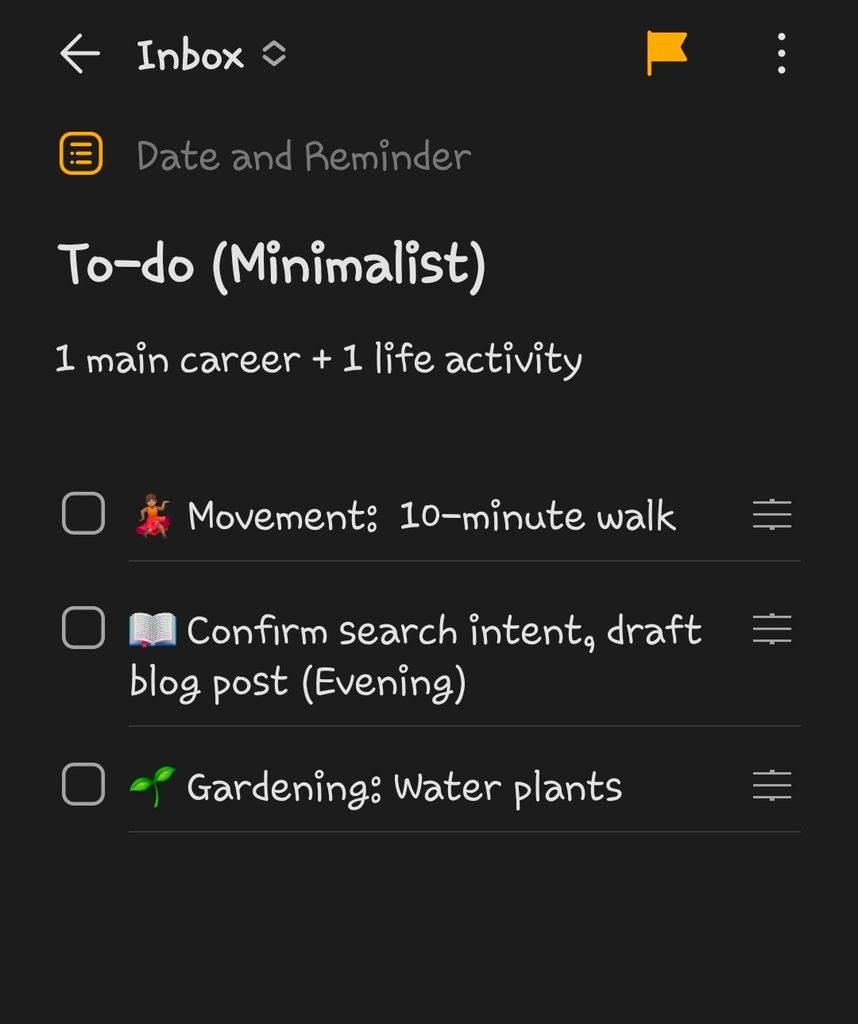
What’s more, resting before I’m tired helps me stay fresh during work hours. And if something unexpected disrupts a day, I ask:
What’s the next smallest useful thing I can do?
If my energy comes back, I can do more. If it doesn’t, that’s okay too.

What I Don’t Do
- I don’t force myself to wake up at 5 a.m. because the internet says successful people do.
- I don’t obsess over perfect Pomodoros, fill every minute of my calendar or treat waking up late as proof I’ve ruined the day.
My take? Try not to obsess over work-from-home productivity tips. What matters is having habits that help you keep showing up.
How to Have a Productive Day at Home (Without Burning Out)
Ask yourself: Am I making some progress without using up tomorrow’s energy? That’s what productivity means. Here’s how to do it:
Use focus blocks
Work on one thing at a time for a flexible 15–50 minute block. Don’t obey the timer like it’s your boss. If your brain is struggling, take a break.
Set communication boundaries
If your job allows it, use status updates, calendar blocks or Do Not Disturb settings to protect deep work.
You don’t need to disappear all day. Let people know when you’ll respond or when you need quiet time. And if you don’t have much control over your schedule, seek help where necessary.
Let technology support you, not create noise
Ever had that “What was I doing again?” You don’t need five productivity apps and AI assistants monitoring your every breath.
Use a simple task list, reminder or automation only when it solves a problem for you. If the tool becomes another thing to manage, simplify.
Protect your essential life vitamins
Sleep. Eat. Move. Talk to people. Have a hobby. Go outside.
These aren’t rewards for being productive enough. They’re part of having a life outside work and energy to return tomorrow.
What if your work-from-home day collapses?
Slow down and reset. Don’t turn a bad day into another productivity battle.
Step 1: Stop and look at what happened.
Low energy? An unexpected meeting? Something at home? Name it without judging yourself.
Step 2: Pick the smallest useful next action.
Finish one small task, send the necessary message or postpone what can wait.
Step 3: Recover and reset.
Take the break you need. Let the rest of the day be what it is. You can begin again tomorrow.
A heavy day doesn’t need a better routine. Sometimes, it just needs less pressure.
So what?
We’ve seen that a realistic and productive work-from-home routine is flexible. It has five adaptable signposts to help you feel less tired. These intentional fixes can help you prevent WFH burnout and enjoy working from anywhere in the world.
I’m curious about you: What’s one thing you’ve tried that helped you stay mentally sane? Comment below.
FAQ
Work-From-Home Routine Basics
What is an effective work-from-home routine?
One that gives you enough structure to know what matters, allows you to adjust workload around your energy and real-life responsibilities.
How can I protect my energy when working from home?
Scale down your routine for disrupted days. Protect breaks and deep-work time. Make room for sleep, movement, relationships and hobbies. Recovery is part of the routine, not a reward.
What if my routine stops working?
Don’t think you’ve failed. Look at what’s changed, remove what no longer helps and adjust the routine. If you’re still exhausted, look beyond your routine too.